
LED Downlight Upgrade Sydney: 2026 Winter Energy Bill Guide
By the team at Tradetek Solutions
The first cold snap of July 2026 hit Sydney last week, and with it the annual winter ritual of every downlight in the house running from 4 pm until bedtime. In a typical Ryde, Chatswood or Baulkham Hills family home built between 2000 and 2015, that means somewhere between 20 and 40 old halogen downlights burning around 50 watts each, six hours a day, for about ninety days straight. It is the single biggest reason Sydney household electricity bills spike in the middle third of the year.
The fix is not clever thermostat scheduling or a smart plug. It is replacing the halogens with modern LED downlights, most of which are eligible for a point-of-sale discount under the NSW Energy Savings Scheme. Booked before the August peak, a typical Sydney home upgrade pays for itself inside two winters and takes a licensed electrician about half a day. This guide covers what the job actually looks like in 2026, what it costs, what the rebate really pays, and the AS/NZS 3000 rules that make a DIY swap illegal in NSW.
Why Sydney Winter Power Bills Are Really a Lighting Bill
Sydney households often blame heating for the July bill jump. The data tells a different story in homes that still run halogens. Heating spikes for six to ten peak weeks. Lighting runs at full tilt from mid-May through to late September. Halogen downlights are also 90 percent heat and 10 percent light, so every dollar spent lighting a room is also heating the ceiling cavity, not the room below.
A single 50 watt MR16 halogen running four hours a day draws roughly 73 kWh a year. At the Sydney residential rate of about 37 cents per kWh in mid-2026, that is 27 dollars a light. Multiply by 25 downlights across a family home and the annual lighting bill sits close to 675 dollars, with more than half of that consumed between May and August. A 7 watt LED replacement in the same fitting drops the same 25-light total to about 96 dollars a year. That is the real 2026 winter number.
The NSW Energy Savings Scheme in Plain English
The NSW Energy Savings Scheme (ESS) is the state government program that pays for upgrades like this by generating tradeable energy savings certificates. Homeowners never see the certificates. What they see is a discount already applied to the invoice by an Accredited Certificate Provider, or by an electrician working under one.
In practical terms for a Sydney home in July 2026, the discount usually looks like this:
- 10 downlight upgrade. Around 90 to 220 dollars off the invoice.
- 20 downlight upgrade. Around 180 to 420 dollars off the invoice.
- 30 downlight upgrade. Around 260 to 620 dollars off the invoice.
- Commercial or strata common area. Quoted per site, generally offsetting 25 to 45 percent of the installed cost.
The discount only applies when the installer is signed up to the scheme and when the fittings on the shelf that day are on the approved product list. Ask about both before the job is booked. If the answer is vague, the rebate will not appear on the invoice.
What a Sydney LED Downlight Upgrade Actually Costs in 2026
Pricing has held steady across Sydney metro through the first half of 2026, with only small movement on driver-integrated fittings. The figures below are supplied-and-installed prices for a licensed job, before the ESS discount.
- Direct replacement, quality dimmable LED. Around 55 to 85 dollars per light installed for 10 or more fittings on the same visit.
- Direct replacement, tri-colour dimmable LED (warm, neutral, cool selectable). Around 70 to 110 dollars per light installed.
- Smart or Zigbee-controllable LED. Around 110 to 160 dollars per light installed, before hub.
- New hole cut into a plastered ceiling. Add 40 to 90 dollars per new fitting for cabling from the nearest circuit.
- Ceiling access issue, tiled second storey or truss roof. Add a one-off site loading of 120 to 280 dollars.
- Compliance certificate (CCEW) and switchboard label update. Included on every job by a licensed electrician.
A common Sydney family home with 25 to 30 existing halogens usually lands between 1,450 and 2,400 dollars before the ESS discount, and between 1,150 and 1,900 dollars after.
Halogen, CFL, Integrated LED: Which One Do You Have?
MR16 halogen with a transformer
The classic 12 volt spot. A silver puck with a glass front and pins on the back, sitting in a chrome or white ring, fed by a chunky iron-core transformer above the ceiling. These are the units that overheat, discolour ceilings and shorten globe life. Almost every Sydney home built between 1998 and 2012 has these.
GU10 mains halogen
A twist-lock 240 volt halogen, no transformer, still around 50 watts and still very hot. Common in early 2010s renovations. Direct LED replacement bulbs exist for these, but they rarely dim well and the fitting itself is often UV-yellowed and worth replacing.
Old CFL downlights
Curly tube compact fluorescents in a downlight housing, common in inner-west apartments and 2010 to 2015 townhouses. They use less power than halogens but take 30 to 60 seconds to reach full output, which is why every hallway feels dim in winter.
Integrated LED (already upgraded)
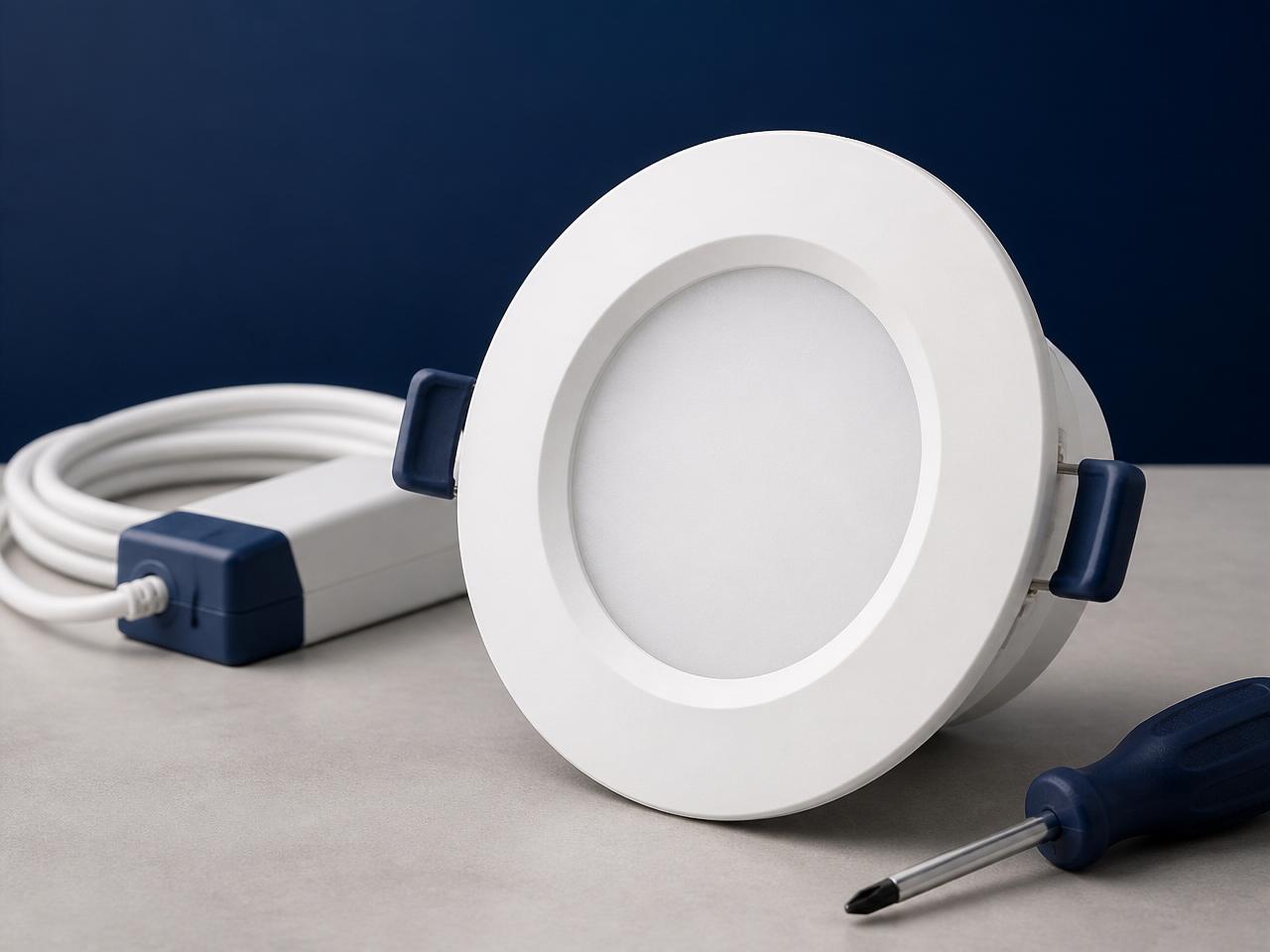
A flat white or brushed silver disc with no removable bulb. If the fitting looks like a single sealed unit and runs cool, it is already an integrated LED and does not need to be swapped. It may still need re-driver work if it has started flickering.
The AS/NZS 3000 Rules That Make a DIY Swap Illegal
In NSW, any work on a fixed lighting circuit is licensed electrical work under the Electricity (Consumer Safety) Act. That includes removing a halogen transformer from above a ceiling and connecting a new LED driver, even when the wiring looks straightforward. The relevant technical rules sit in AS/NZS 3000 (the Wiring Rules), which cover clearance from insulation, correct earthing of Class I fittings and thermal cut-out requirements.
Two rules cause the most retrospective failures on Sydney insurance claims:
- IC-4 rating and insulation contact. Only fittings rated IC-4 (insulation contact, abutted and covered) can sit under ceiling batts. Older LEDs marked IC-F or non-IC still need clearance, and covering them voids the fire rating.
- Driver placement. Drivers must sit on a joist with airflow, not lying on the plaster, and never inside a downlight can. Drivers cooked into ceiling dust are the number one warranty failure the team sees on Sydney callouts.
Always insist on a Certificate of Compliance for Electrical Work (CCEW) at the end of the job. You can verify the installer's licence on the NSW Fair Trading electrician licence check in about a minute.
Colour Temperature: Why Winter Feels Different Under LEDs
A common complaint from Sydney homeowners after a quick supermarket LED swap is that the house suddenly feels clinical. That is a colour temperature issue, not a brightness issue. Winter light indoors is best served by warm tones.
- 2700K warm white. Living rooms, bedrooms, dining. Matches the tone of the old halogens most Sydney homes are used to.
- 3000K soft white. Kitchens, bathrooms with makeup mirrors, hallways. Slightly crisper without going cold.
- 4000K neutral white. Garages, laundries, home offices, workshops. Task lighting only.
- 5000K to 6000K cool white. Retail, medical, commercial. Avoid in Sydney homes unless the fitting is tri-colour switchable.
A tri-colour switchable fitting is the safest choice when a house has multiple room types, because the electrician sets the tone room by room during install.
Dimming: The Detail That Ruins a Cheap Job
The number one Sydney complaint after a DIY or handyman LED job is flickering and buzzing when the dimmer is used. LEDs draw a fraction of the current a halogen dimmer expects, so the old trailing edge or rotary dimmer often sits below its minimum load and stutters. The fix is one of three things.
- Replace the dimmer with a modern LED-rated trailing edge dimmer matched to the driver brand.
- Use a leading-edge compatible LED driver where the existing wall plate cannot be changed easily.
- Move to a smart wall switch that talks to smart drivers over wireless, useful when the same install also adds ceiling fans or a heated towel rail circuit.
A good Sydney electrician quotes for the dimmer at the same time as the downlights. If the quote is only for the lights and does not mention dimmers, ask why before the job is booked.
How the Upgrade Fits the Rest of a Winter Electrical Tune-Up
Booking a LED downlight upgrade in Sydney is one of the rare jobs where it makes sense to bundle other electrical work into the same visit. The switchboard is already isolated, the electrician is already in the ceiling and the labour minimum is already covered.
- Smoke alarm replacement to 10-year sealed lithium. Now mandatory across NSW rentals and worth doing on any home older than a decade. See our guide to Sydney smoke alarm laws 2026.
- Safety switch (RCD) check on the switchboard. Winter appliance load is a good time to press the test buttons and replace anything that does not click. Details on our safety switch installation service page.
- Ceiling fan reverse and service. Running ceiling fans in reverse in winter pushes warm ceiling air back down and cuts heating cost. See our ceiling fans page.
- Switchboard upgrade for EV, solar and induction load. If the meter box still has ceramic fuses, the LED job is the natural moment to modernise. Read the 8 signs you need a switchboard upgrade.
- Bathroom exhaust fan upgrade. Winter mould is a lighting cavity problem as much as a bathroom one. See bathroom exhaust fan installation Sydney.
- Electrical safety inspection. A full report is cheap when the electrician is already on site. See our home electrical safety inspection guide.
What Sydney Homeowners Get Wrong About the Payback
The most common mistake is measuring payback only against the energy bill. That is the biggest saving, but not the only one. Halogen replacement bulbs run around 8 dollars each and last about 2,000 hours. Quality LED fittings run 25,000 to 50,000 hours. Over ten years the avoided globe replacements alone typically cover 25 to 40 percent of the original install cost, before a single kilowatt hour is counted.
There is also the winter insulation dividend. Once the fittings are IC-4 rated and the ceiling batts can sit flush over them, the ceiling starts holding heat properly for the first time. On a typical Sydney weatherboard or brick veneer home that shows up as a one to two degree lift in indoor temperature at the same heater setting, which most homeowners then use to drop the thermostat rather than warm the house further.
For rental properties, the arithmetic is different but still favourable. Landlords carry the install cost, tenants pay the power bill, but the fitting life, insurance position and appeal at re-let time all sit with the landlord. Most Sydney property managers now list an LED-only ceiling as a search filter benefit.
Frequently Asked Questions
Book the Upgrade Before the August Cold Snap
The July to August window is when Sydney electricians hit peak booking pressure, and it is also when the winter power bill lands. The homes that get the biggest saving are the ones booked early enough to be running new LEDs by the second half of winter, not the ones booked in reaction to the September bill. Book a quote now and the fittings can usually be on the ceiling within two weeks.
For a written quote across your Sydney home, contact the Tradetek Solutions team. The visit covers a full count, a fitting recommendation matched to each room, dimmer compatibility and the exact ESS discount you will see on the invoice.