
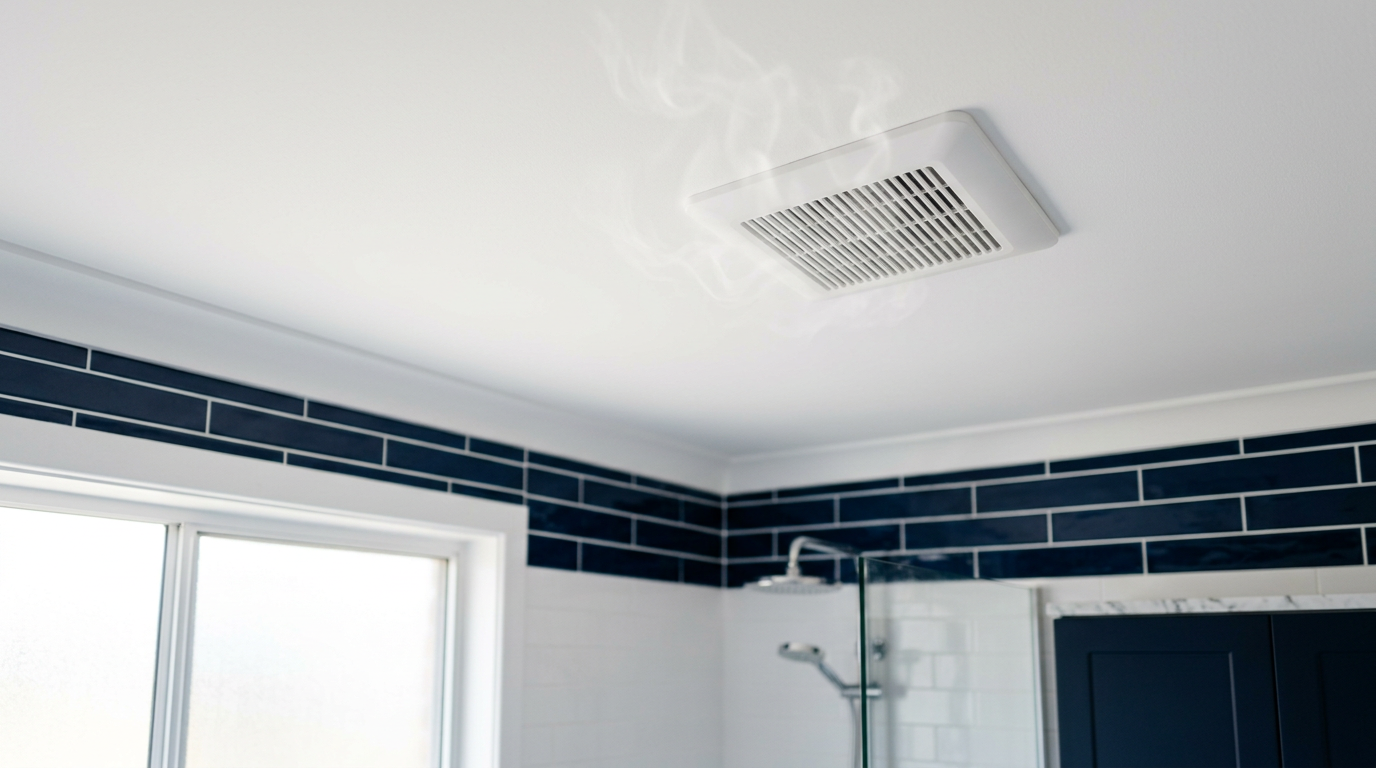
Bathroom Exhaust Fan Sydney: Stop Winter Mould Now
By the team at Tradetek Solutions
Walk into a Sydney bathroom on a wet July morning and you can almost taste the air. The mirror still has water beading on it from last night, the silicone in the shower has a black bloom that wasn't there in May, and the paint above the towel rail is starting to lift. Most homeowners blame the shower, the tiler, or the previous owner. The real culprit is sitting in the ceiling above you, and it is either undersized, switched off too early, or quietly pumping every shower's steam straight into your roof cavity.
Sydney's winter is mild by world standards, but our humidity is not. Coastal suburbs from Cronulla to Manly sit above 70 percent relative humidity for most of June, July and August, and the harbour-side inversion layers trap that damp air against ceilings overnight. A bathroom without proper extraction becomes a 24-hour mould incubator from the first cold snap through to the September westerlies.
This guide covers what an exhaust fan actually has to do in a Sydney bathroom, why most of them fail at it, the rules under AS 1668.2 and the National Construction Code, what a compliant ducted installation looks like, and what a fan upgrade should cost in 2026. The team at Tradetek Solutions books in dozens of these every winter, and the pattern is always the same.
Why Sydney Bathrooms Grow Mould Every Winter
A four-minute hot shower releases roughly two litres of water into the air. Run two showers, a bath and a load of hand-washed laundry through the week and you are dumping 15 to 20 litres of warm moisture into a small, enclosed room. On a cold winter morning that vapour hits the cooler tiles, mirror, ceiling and silicone, condenses, and stays there. Mould spores germinate at around 70 percent relative humidity, and a closed-up bathroom after a hot shower easily sits at 90 percent for hours.
The fan above your head is the only thing standing between that moisture and your plasterboard. If it is the cheap builder-grade unit that came with the house, it probably moves about 75 cubic metres of air per hour, runs only while the light switch is on, and discharges straight into the ceiling space. None of those three things work in a Sydney winter.
You see the result downstream. Black mould lines along the silicone, paint bubbling on the ceiling cornice, rusted screw heads on the fan grille, and a steady musty smell that the cleaning spray never quite kills. Left long enough, the damp migrates into the wall behind the shower and pairs up with the leak failure pattern covered in our guide on leaking shower repair before winter mould sets in.
What NSW Law Actually Requires
Bathroom ventilation in NSW is governed by the National Construction Code, which references AS 1668.2 for mechanical ventilation. The short version for Sydney homes:
- Any bathroom without an openable window directly to outside must have mechanical extraction.
- The extraction must move at least 25 litres per second for a bathroom and 40 litres per second for a combined bathroom and laundry.
- Discharge must be to outside the building. The roof cavity is not outside.
- Wiring and connection of the fan is electrical work that must be done by a licensed electrician under the NSW Fair Trading electrical licensing scheme.
- The circuit must be protected by a residual current device (RCD) as required by AS/NZS 3000, the wiring rules.
Most Sydney homes built before 2010 fail at least one of these. The window-only bathrooms in older terraces rely on the homeowner remembering to open the sash on a 6-degree morning, which nobody does. The 1990s and 2000s brick veneers across Western Sydney almost all vent into the roof cavity, which is why roof ventilation problems and bathroom mould tend to show up in the same house, as covered in our piece on roof ventilation and winter condensation.
The Three Fan Types Sold in Sydney (and Which One You Want)
Ceiling-only fans
These are the small white plastic units with a louvred grille that simply blow air into the ceiling space above. They are cheap, easy to fit and meet absolutely none of the NCC requirements for new work. If you have one and the bathroom has no window, you do not have compliant ventilation. You also have several years of moisture sitting on your insulation batts.
Ducted ceiling fans
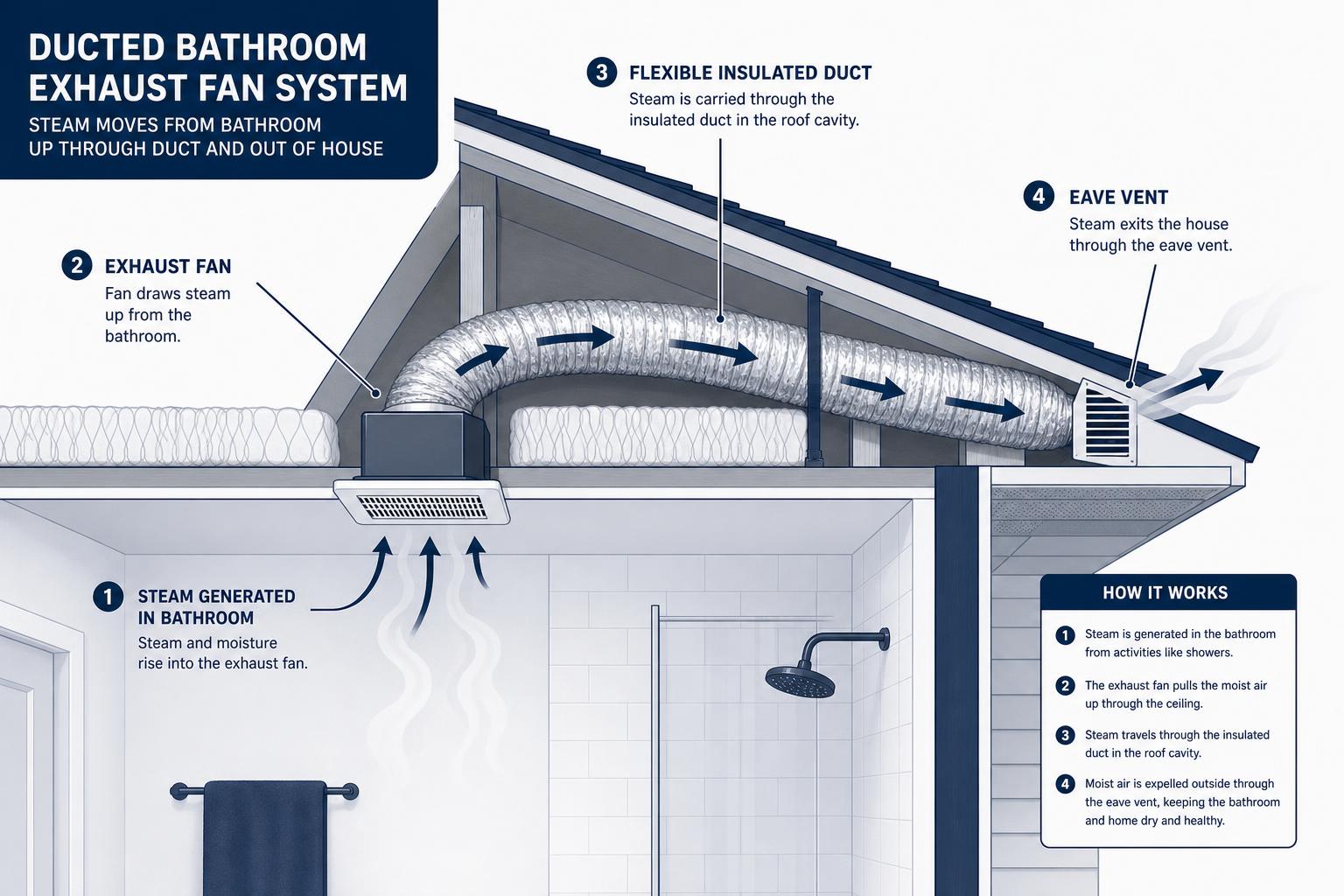
The standard correct choice for almost every Sydney home. A more powerful motor pulls air from the bathroom through a 150mm flexible insulated duct routed across the roof cavity to an eave vent, wall louvre or roof cowl. Done properly, the steam leaves the building within seconds. This is what a licensed electrician will quote on for any retrofit.
Three-in-one units (fan, light, heater)
Popular in family bathrooms because the heat lamps take the edge off a winter morning. Make sure the model has a separately switched fan that can run on a humidistat or timer, otherwise people turn off the whole unit when they leave and the moisture stays. The heater bulbs draw 1000 to 1375 watts each and may need their own circuit, which is where the wider switchboard story in our eight signs you need a switchboard upgrade guide becomes relevant.
Sizing the Fan Properly for a Sydney Bathroom
The most common mistake is buying a fan rated by box label rather than by the room. Use a simple calculation. Multiply the bathroom length by width by ceiling height in metres to get cubic metres, then size the fan to move at least ten of those room volumes per hour.
- Powder room (2.0m by 1.5m by 2.4m, 7.2 m³): about 72 m³/h, or 20 L/s. A small ducted fan handles this easily.
- Standard family bathroom (3.0m by 2.4m by 2.7m, 19.4 m³): about 194 m³/h, or 54 L/s. Choose a quality 150mm ducted fan.
- Main bathroom with separate bath and shower (3.5m by 2.8m by 2.7m, 26.5 m³): about 265 m³/h, or 74 L/s. Step up to a high-flow ducted unit or run two extraction points.
- Bathroom and laundry combined: meet the 40 L/s minimum from AS 1668.2 and add 10 L/s for each extra fixture beyond shower, basin and toilet.
For older Sydney homes with high decorative ceilings (Federation and Victorian terraces commonly 3m or more), the cubic metre count balloons and most builder-grade fans simply cannot keep up. A walk-in survey before quoting matters more than the spec sheet.
The Duct Path Is What Actually Makes the Fan Work
You can buy the best fan on the market and waste every dollar of it with a bad duct run. Sydney installers see the same five duct mistakes again and again.
- Sagging flexible duct. Long unsupported runs sag, collect condensation and form a water trap. The fan then pushes air through a half-blocked tube and slows to a crawl.
- Sharp 90-degree bends. Each tight bend can knock 20 to 30 percent off airflow. Use long sweeping curves and never crush the duct against a rafter.
- Discharge into the roof cavity. Still common in homes from the 1990s and early 2000s. The moisture rusts roof screws, soaks insulation and feeds mould on the underside of the roof deck.
- Uninsulated duct in a cold cavity. Warm bathroom air hits cold metal duct, condenses inside the tube and drips back into the fan housing. Use insulated flex duct.
- External vent in the wrong spot. An eave vent under the prevailing southerly wind in a coastal suburb gets blown back into the cavity. Position vents on the leeward side or use a sealed roof cowl.
Switching, Timers and Humidistats
A fan that only runs while the light switch is on rarely clears the steam, because most people flick the switch off as they leave the room. There are three better options, and a licensed electrician can wire any of them during the same callout.
- Run-on timer. The fan keeps running for a set time after the light goes off. Set it to 15 to 20 minutes in winter and the bathroom is dry before the next user walks in.
- Humidistat. A sensor switches the fan on when relative humidity climbs and off again when it falls. Best for shared bathrooms where shower timing is unpredictable.
- Separate fan switch. Useful for three-in-one units so the fan can run without the heat lamps or light. Adds a second wall plate but pays for itself in winter comfort.
2026 Sydney Installation Costs
These ranges reflect what Sydney homeowners are paying in winter 2026 for licensed electrical work with a warranty and compliance certificate.
- Like-for-like fan replacement on the existing circuit: $280 to $480. Suits a recent ducted fan that has simply worn out.
- New ducted fan with full duct run to an eave or wall vent: $550 to $1,100. The standard upgrade for a 1990s or 2000s home where the old fan dumped into the roof.
- Three-in-one fan, light and heater unit: $650 to $1,400 supplied and installed, depending on brand and whether a new heater circuit is needed.
- Run-on timer or humidistat add-on: $120 to $280 if fitted during the same callout.
- Adding a new RCD-protected circuit or relocating a switch: $200 to $600, occasionally more if the switchboard is full and needs upgrading.
- Eave vent or wall cowl supplied and weatherproofed: $90 to $220 per vent.
If the bathroom is also being renovated, bundle the fan, downlights and any heated towel rail into one electrical visit. The cost per item drops because the sparkie only sets up once. The same logic appears in our 2026 piece on heated towel rail installation in Sydney.
Signs Your Current Fan Has Already Failed
Run through this quick checklist on the next cold morning. If you tick two or more, the fan is not doing its job and the bathroom is racking up damage.
- The mirror is still fogged 15 minutes after a shower with the fan running.
- You can hear the motor straining but cannot feel air pulling toward the grille if you hold a tissue near it.
- The grille is dusty, greasy or has paint sealing the louvres shut.
- There are brown stains around the fan housing or on the ceiling near it.
- You can see daylight or insulation when you remove the grille (which means it vents into the roof, not outside).
- Black mould keeps returning along the silicone or in the ceiling corners within weeks of cleaning.
- The fan only runs while the light is on and the light gets switched off as people leave.
What a Good Install Day Looks Like
A retrofit on a standard Sydney bathroom usually takes two to four hours. A licensed electrician isolates the circuit, removes the old fan, cuts the ceiling opening to suit the new housing if needed, runs new insulated duct across the roof cavity, fits the external vent through the eave or wall, wires the fan with proper terminations, tests RCD operation, and provides a Certificate of Compliance Electrical Work (CCEW). The room is left cleaner than it started.
For renovations, coordinate the electrical visit before the painter and after the plasterer. New ceiling fixings need to be made off solid framing, and patching around a fresh fan housing always looks better than chasing one in over finished paint. If you are also pulling out the shower, this is the right moment to book a leak detection and re-waterproof, because the bathroom only gets opened up once.
Picking a Sydney Electrician for the Job
Three things matter. Make sure the trade is fully licensed by checking the NSW Fair Trading licence verification tool. Ask whether they will provide a CCEW on completion. And confirm in writing that the fan will discharge outside the building, not into the roof cavity. Any quote that skips one of these is not really a quote, it is a future repair bill.
Tradetek Solutions is fully licensed across plumbing, electrical and roofing trades, so the same job can be coordinated end to end without three separate site visits. Coverage includes Sydney metro, the Central Coast and the Newcastle and Hunter region, with most fan upgrades completed inside a single morning booking.
Book the Fan Before the Next Storm Front
East Coast Low systems tend to roll across Sydney from late June through August, and they bring days of low cloud and saturated air with them. A bathroom that already struggles with moisture cannot cope with a week of 90 percent humidity outside, and that is when the damage curve goes vertical. Booking a compliant exhaust fan now is the cheapest piece of moisture control you can put into a Sydney home this winter.
Call Tradetek Solutions on 0488 822 794 to book a licensed electrician for a bathroom fan assessment, fan upgrade or full bathroom electrical refit. Same-day availability across most Sydney suburbs.