
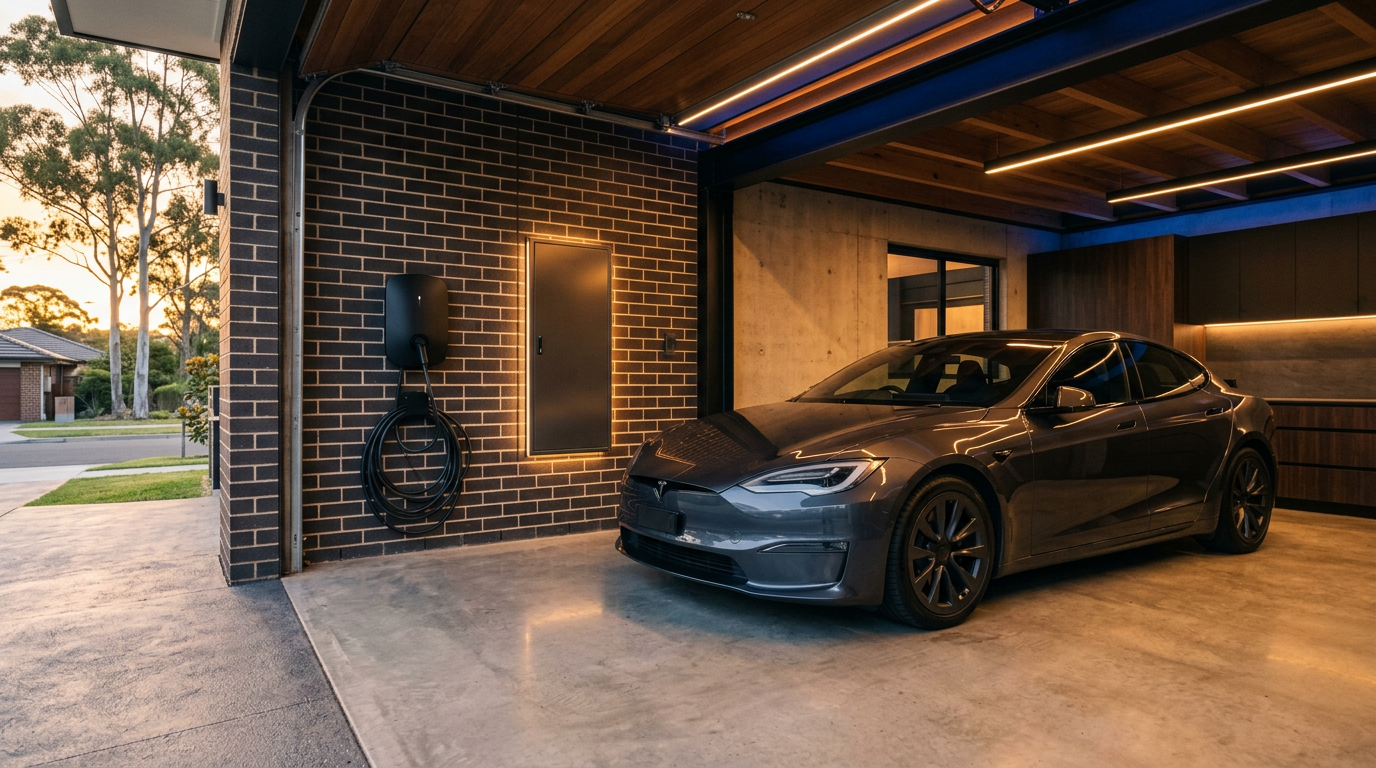
Home EV Charger Installation in Sydney: 2026 Guide
By the team at Tradetek Solutions
Drive through Mosman, Ryde or the Hills District on any given evening in May 2026 and the change is impossible to miss. Tesla Model Ys sit alongside BYD Sealions in driveways that, two years ago, only had petrol cars. Sydney is now the largest electric vehicle market in Australia, and with the federal Fringe Benefits Tax exemption still pulling new EVs onto local streets every week, demand for proper home charging has never been higher.
The trouble is that most Sydney homes were not wired with electric cars in mind. The standard 10 amp power point in your garage will work in an emergency, but it is slow, inefficient and was never designed to run for ten hours a night. A dedicated home charger is faster, safer and far cheaper to run, but it has to be installed correctly by a licensed electrician under AS/NZS 3000 wiring rules.
This guide walks you through everything a Sydney homeowner needs to know in 2026: the difference between Level 1 and Level 2 charging, what your switchboard has to do, how Ausgrid and Endeavour Energy are involved, what a quality installation looks like, and the questions you must ask before any electrician quotes the job. By the end you will know exactly what to plan for and what to budget your time around.
Level 1 vs Level 2 vs DC Fast Charging
The first thing to settle is what kind of charger you actually need. EV charging in Australia is split into three levels, and only two of them belong at home.
- Level 1 (trickle charging) uses a portable cable plugged into a normal 10 amp household power point. It delivers around 2 to 2.4 kilowatts and adds roughly 10 to 15 kilometres of range per hour. It is fine for plug-in hybrids and very low daily mileage.
- Level 2 (AC home charging) uses a hardwired wall unit on its own dedicated circuit. Single-phase units deliver up to 7.4 kilowatts and add around 40 kilometres of range per hour. Three-phase units can reach 22 kilowatts and fill most batteries overnight in a few hours.
- DC fast charging is the public network you see at NRMA and Evie sites. These run at 50 kilowatts or more and are not used for residential installations. They require dedicated grid infrastructure and engineered cooling.
For ninety percent of Sydney households a single-phase 7 kilowatt Level 2 charger is the right answer. It comfortably refills a daily commute overnight, works on the standard household supply, and avoids the cost and approval delays of a three-phase upgrade. Drivers in larger homes with two electric vehicles or a long Central Coast commute should consider 22 kilowatts if three-phase power is already at the property.
The Switchboard Question Most Sydney Quotes Skip
A 7 kilowatt charger draws around 32 amps continuously while charging. That is more than a ducted air conditioner and more than an electric oven, running for hours at a time. Your switchboard has to safely carry that load on its own dedicated circuit, with its own Residual Current Device protection.
Many homes built before the year 2000 cannot do this without modification. The clues are easy to spot once you know what to look for: ceramic fuses instead of modern circuit breakers, fewer than ten breakers in total, no Residual Current Devices on the lighting circuits, or a board that is already physically full. Adding an EV circuit to a marginal switchboard creates nuisance tripping at best and a fire risk at worst.
A genuine quote always includes a switchboard inspection. If yours needs work, the right answer is to combine the EV installation with a switchboard upgrade or full electrical panel replacement. Doing both at the same time costs less than doing them separately and means the new charger lands on a board that will last another twenty years. Watch for any quote that does not even mention your switchboard. That installer is planning to bolt a high-load circuit onto whatever is already there and hope for the best.
Single-Phase or Three-Phase: What Sydney Homes Actually Have
Sydney's residential electrical supply is a patchwork. Older inner-suburb terraces in Glebe, Newtown and Annandale are almost universally single-phase. Newer homes in the Hills, Western Sydney growth corridors and most apartments built after 2010 are often three-phase. Knockdown rebuilds in Mosman and Lane Cove can be either, depending on what the previous owner specified.
Why does it matter? A single-phase service caps your charger speed at about 7.4 kilowatts. A three-phase service unlocks 11 and 22 kilowatt units. Three-phase also lets the charger spread the load across all three phases, which is gentler on the network and on your switchboard.
You can usually tell by looking at the main switch in your switchboard. A single black or red main switch handle means single-phase. Three handles ganged together, or a single wide handle controlling three poles, means three-phase. If you are not sure, your electrician will confirm it during a no-obligation electrical inspection. Upgrading from single-phase to three-phase is possible but involves Ausgrid or Endeavour Energy, often a new service cable from the street, and a meaningful timeline. For most Sydney homes a single-phase 7 kilowatt charger is the smarter starting point.
Choosing the Right EV Charger for Your Home
The Australian market in 2026 is crowded. Tesla, Wallbox, Zappi, EVSE, Ocular, Schneider, ABB and a dozen others all sell residential units. Rather than getting lost in brand comparisons, focus on five practical features that actually matter for a Sydney install.
1. Tethered or Untethered Cable
A tethered unit has the charging cable permanently attached. It is faster to use day to day because you simply unhook it and plug into the car. An untethered unit is a socket only, so you carry the cable from the car to the wall every time. Tethered is more convenient. Untethered is more flexible if you ever change to a car with a different connector or want to share the unit.
2. Type 2 Connector
Every new EV sold in Australia uses the Type 2 plug. Avoid Type 1 chargers entirely, even if they are cheaper. They will not match your next car.
3. Dynamic Load Management
This is the single feature that saves Sydney homeowners the most money. Dynamic load management lets the charger automatically reduce its draw when other large appliances kick in, so your main switch never trips. In practical terms, it often removes the need for a switchboard upgrade entirely. If you are running a heat pump hot water system, ducted air conditioning and an EV on the same single-phase service, this feature pays for itself in the first month.
4. Solar Integration
If you already have rooftop solar, choose a charger that can divert excess generation straight into the car instead of exporting it back to the grid for a few cents. Zappi and Ocular models are the most popular for this in Sydney because their solar tracking is reliable and the apps are straightforward.
5. OCPP Compliance and Smart Scheduling
Open Charge Point Protocol compliance means the charger will keep working with future apps, energy retailer Virtual Power Plant programs and any time-of-use tariff your retailer offers. Smart scheduling lets you set the charger to only draw power between 11 pm and 6 am, when off-peak rates can be a fraction of the daytime price.
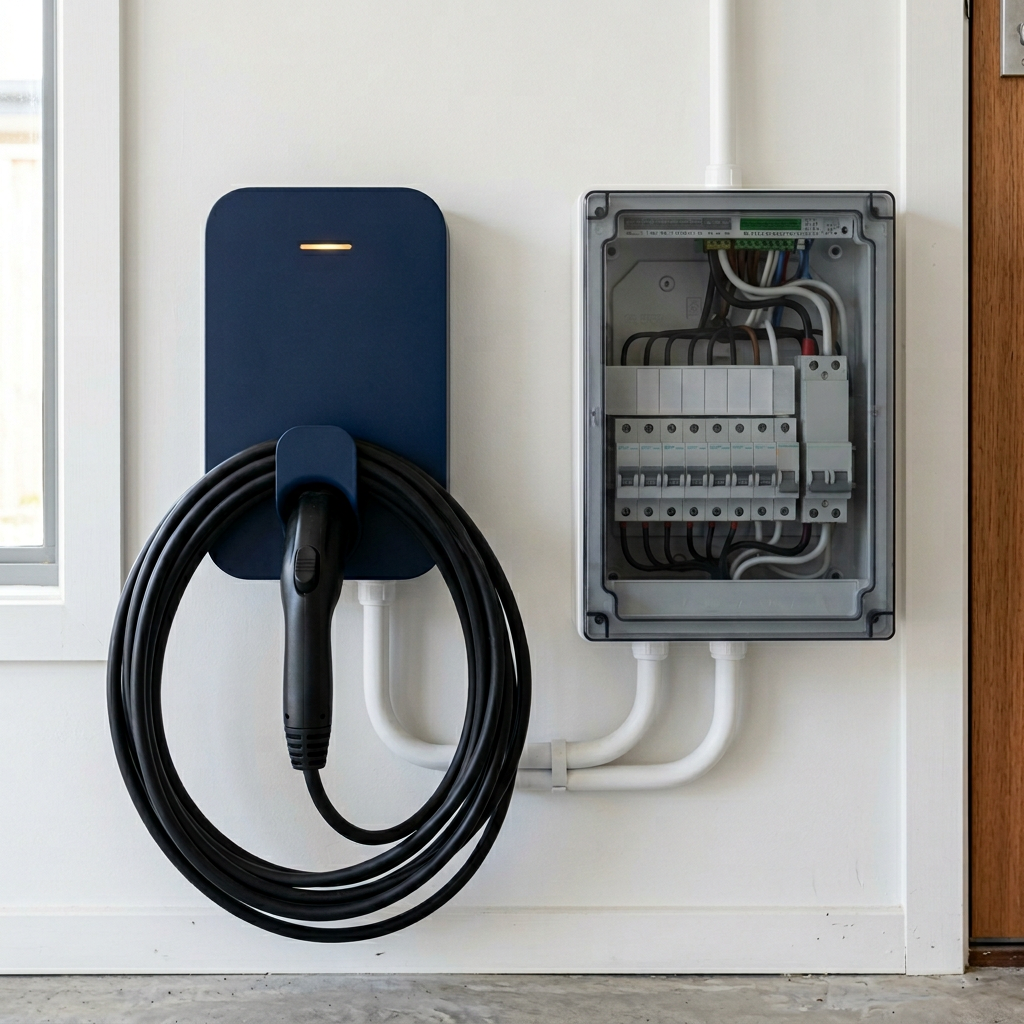
What a Compliant Sydney Installation Actually Looks Like
A compliant home EV charger installation is more than mounting a box on a wall. The licensed electrician follows a defined sequence designed to protect you, your home and the network.
- Pre-installation switchboard inspection and load calculation against AS/NZS 3000.
- Installation of a new dedicated circuit, usually 6 millimetre squared cable for a 32 amp single-phase charger, with appropriate mechanical protection where it passes through walls, ceilings or external runs.
- Installation of a Type B Residual Current Device inside the switchboard, because EV chargers can produce direct current leakage that ordinary Type AC devices will not detect.
- Mounting the charger at the manufacturer-specified height, away from gas appliances and water sources, with weather protection if the unit is outdoors.
- Commissioning, polarity and earth fault testing, and Residual Current Device trip testing under load.
- Lodgement of a Certificate of Compliance Electrical Work with the network provider and a copy supplied to you for your records.
- A walk-through of the charger app, scheduling, solar integration and emergency stop procedure.
If any of these steps are missing from a quote, ask why. The Certificate of Compliance Electrical Work is your legal proof that the work was done by a licensed electrician to current standards. Insurance companies routinely ask for it after any EV-related incident, and it is required for any future electrical compliance certificate the property may need.
Permits, Network Rules and the Ausgrid Notification Process
Sydney homeowners often worry about council approval for an EV charger. There is none required for a typical residential install. The relevant authority is your distribution network operator, which for most of Sydney is Ausgrid, and for the south-western and outer western suburbs is Endeavour Energy.
For a single-phase charger up to 7.4 kilowatts on an existing supply, the process is a notification only. Your electrician completes the work, lodges the Certificate of Compliance Electrical Work and that is the end of it. For a three-phase charger, a service upgrade or any installation that combines an EV charger with a battery storage system, a connection application is submitted before the work begins. Approval typically takes one to three weeks. Building this lead time into your purchase plan, especially if your car is arriving from a factory order, prevents the frustrating gap between car delivery and a working charger.
Apartment owners face a different process. Strata committees in Sydney are increasingly setting EV-ready policies, and the NSW Government has published guidance on this through NSW Fair Trading. If you are in a strata building, raise the topic at your next general meeting and ask for a building-wide load study before committing to a private install.
Rebates, Tax Treatment and the Real Running Cost
The Federal Government's Fringe Benefits Tax exemption on eligible electric vehicles novated through salary packaging remains the headline financial driver in 2026. It does not directly fund the home charger, but it makes the entire ownership picture significantly cheaper for many Sydney workers. The Australian Taxation Office publishes the cents-per-kilometre home charging rate that salary packaging providers can reimburse, which the ATO updates annually.
On the state side, the original NSW EV charger rebate has now closed to new applicants, but several energy retailers still offer credits for joining a managed charging Virtual Power Plant. AGL, Origin and Amber all have programs in 2026 that pay between fifty and two hundred dollars for letting the retailer schedule your charging during off-peak windows. Your installer will know which programs are compatible with the charger you are buying.
For day-to-day running cost, a Sydney driver covering 15,000 kilometres a year in an average electric vehicle uses around 2,600 kilowatt-hours of charging annually. On a typical off-peak tariff that is roughly equivalent in fuel cost to a small petrol hatchback driving 4,000 kilometres a year. The NSW Government's energy efficiency portal has comparison tools that let you model your specific tariff and driving pattern.
Common Mistakes to Avoid
After hundreds of Sydney installations, the same handful of mistakes keep appearing. Avoid these and your charger will give you ten trouble-free years.
- Buying the charger before the electrician inspects the site. A particular model might not suit your supply or your wall. Get the assessment first, then buy.
- Mounting the charger too far from the parking spot. A standard tethered cable is around 5 metres. If the car parks 7 metres away the cable will not reach, and longer aftermarket cables are expensive.
- Skipping the switchboard upgrade to save money. The saving disappears the first time the main switch trips on a 38 degree summer evening with the air conditioner running.
- Ignoring the Type B Residual Current Device requirement. Some unlicensed installers fit a standard Type AC device because it is cheaper. This breaches AS/NZS 3000 and voids the warranty.
- Not asking for the Certificate of Compliance Electrical Work. Without it you have no legal proof the work was certified, and your insurer can decline a claim.
- Forgetting outdoor weather protection. Sydney's coastal salt and the heavy summer storms eat exposed cabling. Ask your installer to fit a weatherproof enclosure for any outdoor unit.
Why Winter Is the Best Time to Book
The local trades calendar is predictable. October through February is peak storm season for emergency electrical work, when the same licensed electricians who install EV chargers are tied up restoring power after southerly busters. Lead times for an EV install can stretch from two weeks in winter to six weeks in summer.
Booking your install in May, June or July also gives you the full benefit of off-peak overnight tariffs, which are typically wider and cheaper during cooler months when grid demand is lower. If your car arrives in late autumn, lock in your installation before spring and you will be charging at the lowest rates of the year while your neighbours are still using public chargers.
Frequently Asked Questions
Get Your Sydney Home EV-Ready Before Winter Ends
A correctly installed home charger is the single biggest convenience upgrade you will make as an EV owner. It turns charging into something you stop thinking about, and it locks in the cheapest electricity rates available to a Sydney household. The work is not complicated when it is done by a licensed electrician who treats the switchboard, the cable run and the Residual Current Device with the care AS/NZS 3000 demands.
The team at Tradetek Solutions installs Level 2 chargers across the North Shore, the Hills, Ryde, the Northern Beaches and the Central Coast. Every quote includes a full switchboard inspection, a written scope of works and the Certificate of Compliance Electrical Work on completion. We work with all major charger brands and can integrate the install with existing solar, batteries and home automation. Talk to us before your car arrives and we will have you charging on the first night.
Book Your Free EV Charger Site Assessment
A licensed Tradetek electrician will inspect your switchboard, plan the cable run and quote the full job in writing.
Call 0488 822 794